
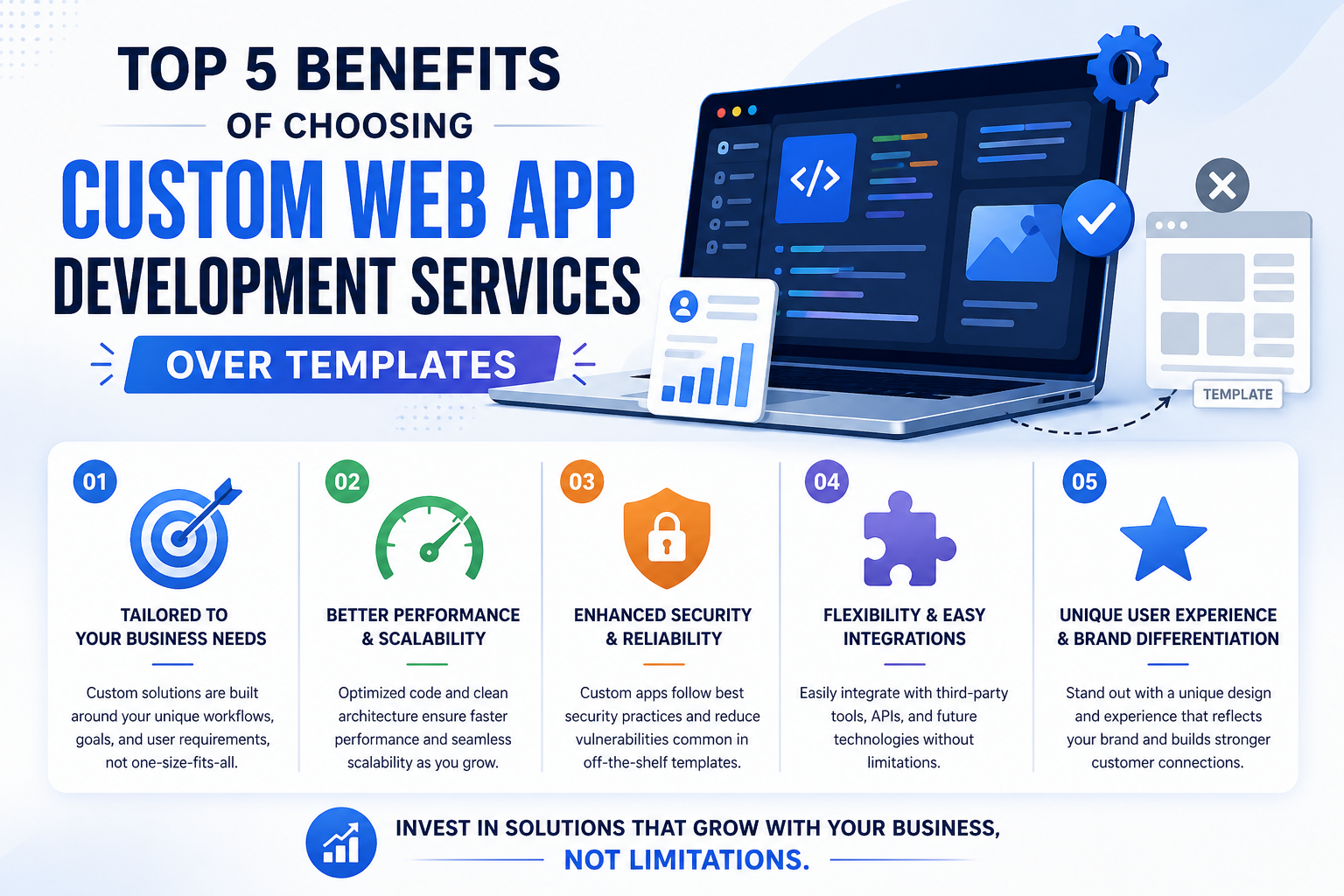
Businesses today need more than a good-looking website. They need a digital asset that drives real revenue. That is exactly why custom web app development services are no longer a luxury — they are a strategic necessity. Over 1.9 billion websites compete for attention online. A cookie-cutter template cannot deliver the performance, security, and brand differentiation modern businesses demand. Furthermore, whether you are a growing startup or an established enterprise, custom web application development consistently outperforms template-based solutions. This guide breaks down the top five benefits backed by data, expert insight, and real-world results.
The Templates vs. Custom Development Debate: Where Does It Stand in 2026?
Templates have their place. For a freelancer launching a portfolio site or a local business testing the waters online, a $50–$200 template from platforms like Wix, Squarespace, or WordPress can get the job done quickly. Templates offer a speedy setup and a wide variety of choices catering to diverse industries, making them a popular option for startups and small businesses.
But here is the reality: as businesses plan for long-term growth, the limitations of templates become evident from over-reliance on third parties and generic designs to limited SEO optimisation and bloated code that reduces ranking potential.
The web development market is booming, valued at $74.69 billion in 2025 and projected to reach $104.31 billion by 2030 a clear signal that businesses are investing heavily in professional, scalable web solutions. And the lion’s share of that investment is flowing toward custom builds.
Let us dig into exactly why.
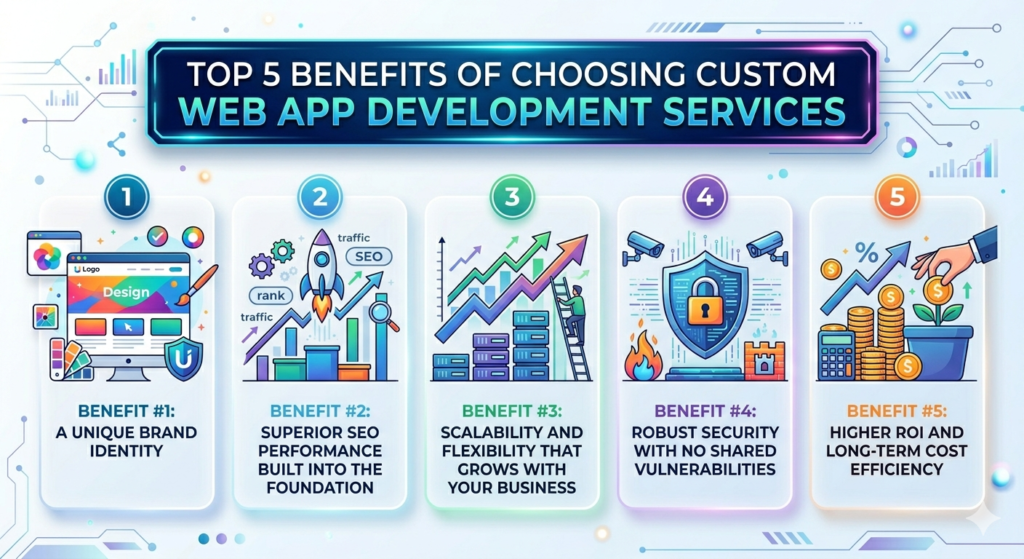
Benefit #1: A Unique Brand Identity That Templates Simply Cannot Replicate
When you invest in custom web app development services, you are not just buying a website. You are building a digital identity engineered around your brand, your audience, and your goals.
Why Templates Fall Short on Branding
Templates appeal to as many buyers as possible. As a result, they rarely suit any one business perfectly. Rigid layouts and predetermined blocks make it hard to tell your unique story. Consider what that means in practice:
- Your competitors may use the exact same template — same layout, same fonts, same structure.
- Visitors form a first impression in under 3 seconds. A generic design weakens trust instantly.
- A unique, professional design builds credibility. Additionally, it helps you stand out in a crowded market.
What Custom Development Delivers Instead
Custom web development services give your team a true blank canvas. Every pixel, every user flow, and every interaction is crafted specifically to reflect your brand. You are not fighting the template — you are building for your audience. Furthermore, as your brand evolves, a custom build evolves with it. Templates, by contrast, lock you into a fixed aesthetic that thousands of other businesses share.
“Think of a custom site as building your own house versus renting an apartment. The investment is greater, but so is the freedom and long-term value.” — David Kim, Technology Consultant
Template limitations at a glance:
- Rigid, pre-set layouts with limited flexibility
- Shared designs across thousands of other businesses
- Hard to differentiate as your brand evolves
- Layout restrictions that require fighting the system, not working with it
Benefit #2: Superior SEO Performance Built Into the Foundation
SEO is not something you bolt onto a template after launch. It must live inside the architecture from day one. That is precisely where custom web application development holds a decisive advantage over template-based builds.
Speed and Code Quality
Custom web development services give you full control over site speed — a major Google ranking factor. Templates carry bloated, unused scripts, features, and third-party plugins. This slows load times and hurts rankings. Custom sites, however, include only what they need. They are leaner, faster, and built to perform.
Technical SEO Advantages
Beyond speed, custom builds unlock deeper technical SEO control:
- Full meta tag and URL control — structured precisely for search engine visibility
- Schema markup implementation — helping Google qualify your content for rich snippets
- Clean semantic code — eliminating framework bloat that crawlers penalise
- Proper heading hierarchy — built for both users and search engine crawlers
- Accessibility optimisation — broader reach and stronger usability signals
The Bottom Line on SEO
A template might be SEO-friendly. A custom site, however, is SEO-optimised. There is a significant difference. Moreover, that difference shows up directly in your organic traffic numbers and search rankings over time.
Benefit #3: Scalability and Flexibility That Grows With Your Business
One of the strongest arguments for custom web app development services is scalability. When your business grows, your website must grow with it. Templates, unfortunately, are notoriously poor at accommodating that growth.
How Template Limitations Compound Over Time
Over time, template ceilings become impossible to ignore:
- Layout restrictions block new feature additions
- Poor mobile responsiveness frustrates users
- Incompatible plugins create performance conflicts
- Accumulated unnecessary code slows everything down
Custom Builds Adapt to Emerging Technology
Unlike templates, custom websites adapt to new trends and technologies. They handle integrated booking systems, multi-language content, complex contact forms, and high traffic volumes with ease. Additionally, they are built to support where digital experiences are heading:
- AI-driven personalisation — dynamic content based on user behaviour
- Voice search optimisation — designed for natural language queries
- Web3 compatibility — decentralised apps and blockchain integrations
- AR/VR experiences — increasingly mainstream in e-commerce and education
Why Custom Web Portal Development Matters Here
Custom web portal development is particularly powerful for scalability. Portals managing large user bases, complex permissions, multi-role dashboards, and real-time data integrations simply cannot run on a template framework. Therefore, custom architecture gives you the foundation to add features, expand, and pivot confidently as your business demands it.
Benefit #4: Robust Security With No Shared Vulnerabilities
Security is where template-based solutions carry a risk that many business owners underestimate. Templates — especially WordPress-based ones — depend heavily on third-party plugins. Those plugins, however, are a prime hacker target.
The Hard Numbers on Template Vulnerabilities
The 2024 data is alarming:
- 7,966 new vulnerabilities were discovered in the WordPress ecosystem — a 34% increase over 2023
- 96% of WordPress vulnerabilities came from third-party plugins
- 43% required no authentication — meaning anyone could exploit them without logging in
This is a serious risk for any business storing customer data, processing payments, or running user authentication.
How Custom Code Eliminates Shared Risk
Custom code stays unique. Hackers cannot run automated attacks against code they have never seen. Security therefore improves through obscurity alone. Furthermore, with custom web app development services, security is engineered from the start:
- Custom authentication flows — built to your exact requirements
- Zero dependency on vulnerable plugins — every feature is purpose-built or fully vetted
- Regulatory compliance built in — GDPR, HIPAA, PCI-DSS aligned from day one
- Proactive monitoring — managed by your development partner, not a plugin marketplace
The Cost of Getting It Wrong
According to IBM’s 2024 Cost of a Data Breach Report, the average breach now costs $4.88 million. That figure, consequently, makes even a significant investment in custom web application development look like excellent value. For businesses handling sensitive data or financial transactions, the security case for going custom is unanswerable.
Benefit #5: Higher ROI and Long-Term Cost Efficiency
This is the benefit that surprises most business owners. Many initially balk at custom web application development cost. However, in the long run, custom development is often the more cost-effective choice.
Yes, the upfront investment is higher. For instance, a 2024 analysis by Forbes places the cost of a professional custom website anywhere from $1,000 to $150,000 and beyond. Additionally, for full web applications, mid-range projects average $15,000 to $30,000, while complex web apps start at $50,000+.
But consider what you get in return. According to Clutch’s 2024 Web App Development Pricing Guide, businesses investing in web apps see a 3x to 5x ROI. Furthermore, those returns are generated through subscription models, e-commerce sales, and process automation — not just one-time wins.
Even more striking is the UX angle. Specifically, a Forrester Research study found that every dollar invested in UX brings $100 in return — an ROI of 9,900%. As a result, a well-executed custom website delivers across multiple fronts:
- Higher conversion rates due to better user experience and brand alignment
- Lower churn, because improved site performance keeps users engaged
- Reduced maintenance costs, since the site is built to evolve rather than be replaced
- Increased SEO visibility that consequently brings consistent, compounding organic traffic
Templates, meanwhile, carry hidden long-term costs that quietly erode their apparent affordability. Specifically, these include:
- Recurring plugin subscription fees that compound over time
- Developer costs to fight template limitations — often more expensive than building custom from the start
- Lost revenue from slow load times and poor UX — directly measurable in bounce rates and conversions
- Redesign costs when the business outgrows the template, which typically happens within 2–3 years
- Vendor lock-in — switching templates later is a complex process, especially when content is tightly tied to the template’s structure
The math, when calculated over a 3–5 year horizon, consistently favours the custom approach for any business with genuine growth ambitions.
Understanding Custom Web Application Development Cost: What Should You Budget?
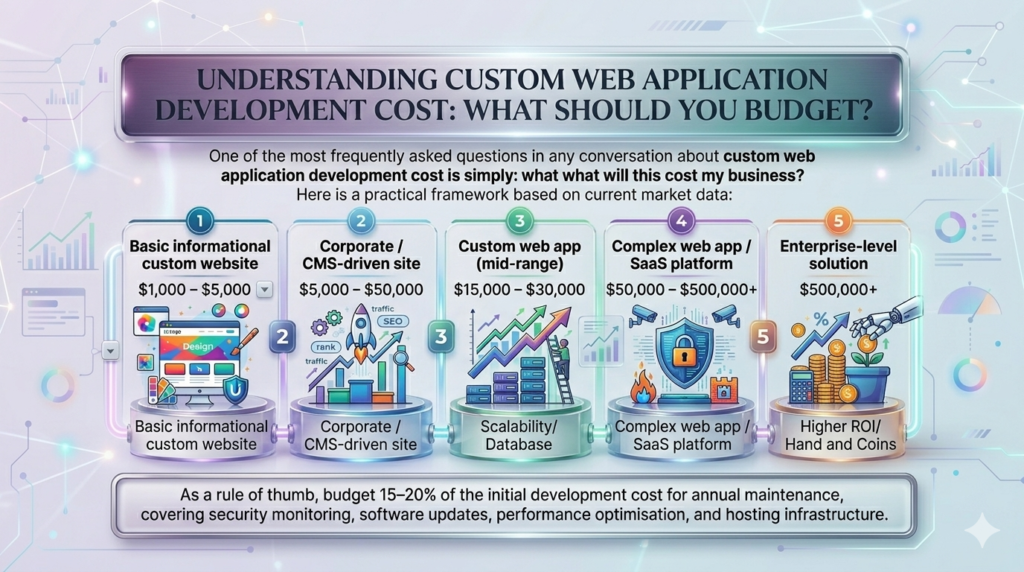
One of the most frequently asked questions in any conversation about custom web application development cost is simply: what will this cost my business?
Here is a practical framework based on current market data:
| Project Type | Estimated Cost Range |
| Basic informational custom website | $1,000 – $5,000 |
| Corporate / CMS-driven site | $5,000 – $50,000 |
| Custom web app (mid-range) | $15,000 – $30,000 |
| Complex web app / SaaS platform | $50,000 – $500,000+ |
| Enterprise-level solution | $500,000+ |
Annual Maintenance Budget
As a rule of thumb, budget 15–20% of the initial development cost for annual maintenance, covering security monitoring, software updates, performance optimisation, and hosting infrastructure.
The best approach for most growing businesses is to start with an MVP (Minimum Viable Product) validate your core functionality, gather user feedback, and iterate. This keeps initial custom web application development cost manageable while still delivering a production-grade, scalable foundation.
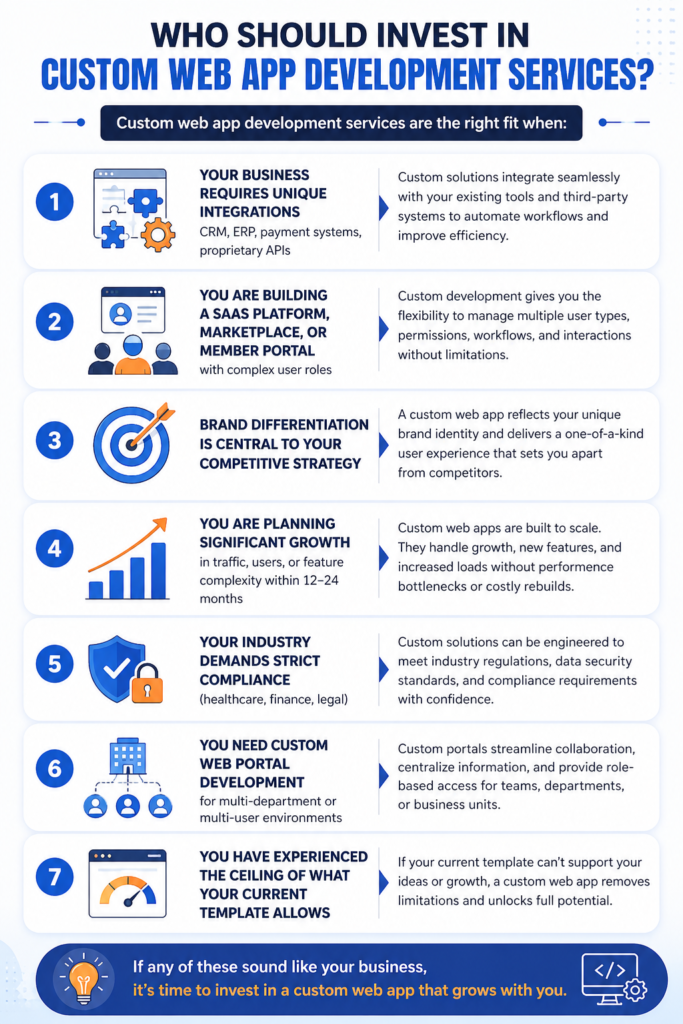
Who Should Invest in Custom Web App Development Services?
Custom web app development services are the right fit when:
- Your business requires unique integrations CRM, ERP, payment systems, proprietary APIs
- You are building a SaaS platform, marketplace, or member portal with complex user roles
- Brand differentiation is central to your competitive strategy
- You are planning significant growth in traffic, users, or feature complexity within 12–24 months
- Your industry demands strict compliance (healthcare, finance, legal)
- You need custom web portal development for multi-department or multi-user environments
- You have experienced the ceiling of what your current template allows
Final Verdict: Templates Are a Starting Point Custom Is a Destination
Templates serve a purpose. For a business testing an idea or launching a minimal online presence on a tight timeline, they are a practical starting point. But for businesses that view their website as a revenue-generating asset not just a digital brochure custom web app development services deliver outcomes that no template can match.
The combination of unique brand identity, SEO-ready architecture, genuine scalability, enterprise-grade security, and long-term ROI creates a compelling case that goes well beyond aesthetics. While custom web development requires a higher upfront investment, it reduces dependency on third-party services and offers greater ROI in the long run.
The digital landscape in 2026 rewards businesses that are fast, distinctive, secure, and built to scale. That is precisely what professional custom web app development services are designed to deliver.
Frequently Asked Questions About Custom Web App Development Services
Custom web app development services refer to the end-to-end process of designing, building, and deploying web applications that are built from scratch or heavily architected to meet a specific business’s unique requirements. Unlike templates, nothing is recycled or pre-packaged. Every feature, user flow, database structure, and interface element is purpose-built around your goals, your audience, and your industry.
Costs vary based on scope and complexity. Here is a quick guide:
Basic custom website: $1,000 – $5,000
Corporate/CMS-driven site: $5,000 – $50,000
Mid-range custom web app: $15,000 – $30,000
Complex SaaS/marketplace: $50,000 – $500,000+
Budget an additional 15–20% of your build cost annually for maintenance.
Timelines depend on complexity. A standard custom web application development project typically takes anywhere from 3 to 6 months from discovery to launch. More complex platforms multi-role portals, SaaS products, or enterprise applications can take 9 to 18 months. Starting with an MVP (Minimum Viable Product) is the most efficient approach: it gets a functional version live faster, allows real user feedback, and reduces initial custom web application development cost.
For businesses with serious growth goals, yes overwhelmingly so Moreover According to Clutch’s 2024 Web App Development Pricing Guide, businesses that invest in custom web apps see a 3x to 5x ROI. Templates carry hidden long-term costs plugin fees, redesign expenses, developer workarounds, and lost conversions due to poor performance that frequently exceed the cost of going custom from the start.
Custom web portal development means building a secure, role-based platform for specific user groups — employees, clients, or vendors. You need it when your business requires a centralised hub for data or workflows that standard templates simply cannot support.
Yes — and many businesses do exactly that. Launch with a template to validate your concept, then migrate to a custom build once growth demands it. Plan the transition early and choose a development partner who can build a scalable roadmap from the start.
Look for a partner who:
Has a strong portfolio of projects in your industry or complexity level
Offers transparent project scoping and pricing models (fixed-price or time-and-materials)
Follows agile development practices with regular milestone reviews
Provides post-launch support and maintenance packages
Can demonstrate experience with security compliance relevant to your sector (GDPR, HIPAA, PCI-DSS)
The right partner in custom web app development services is not just a vendor they are a long-term technical collaborator invested in your business outcomes
Ready to explore what a custom build could look like for your business? The right web development partner will help you scope your project, define your requirements, and build a digital asset that works as hard as you do.