
Moving house is among the leading stress factors in life second only to changing jobs or getting through a divorce. It is stressful, time-consuming, and, frankly speaking, it is quite overwhelming when one only thinks about organizing dozens of service providers, paperwork, budgeting issues, exploring new neighborhoods, etc. That’s why learning how to develop a relocation concierge mobile app has become a hot topic for businesses and startups aiming to simplify this process for users worldwide.
This is precisely the reason why the growth of relocation concierge apps is tremendous at the moment. The Grand View Research estimated that the market of the world In 2018, global concierge services had a market size of $537,6M and a CAGR of 5.3% between 2019 and 2025. They are not mere moving apps that will assist you in getting a truck, but are all-inclusive platforms that will serve as your personal moving assistant, helping you with everything, finding your new house, connecting utilities, the best local schools, and who can help you move, among other things, recommending movers that are reliable in your neighborhood.
Wondering How to Develop a Relocation Concierge Mobile App that people will be eager to use, this guide will lead you through all the necessary steps of the first planning and market research to the launch and monetizing options.
What Exactly Is a Relocation Concierge App?
A relocation concierge application is all your moving support system in one mobile application. You will not have to go around placing apps on your phone or Googling on the Internet about movers, visiting various sites, calling each utility company one after another, trying to understand which neighborhoods have good schools, because everything is in one app and with personal guidance during the whole process of moving.
The following is what distinguishes these concierge apps compared to traditional moving tools:
- Full Service Integration: Everything under one roof: Property search, mover referral, utility management, document management and more: search, book mover, connect, manage and track your move.
- Directly Planned: A relocation app that is more personalized: AI-based relocation apps offer homes, schools, visas, etc. according to your family, financial status, and schedule.
- Free concierge Service: Personalized service: Your moving concierge on speed dial is provided by real-time support, troubleshooting and personalized advice.
- Task Management and automation: Smart concierge app automated tasks, reminders and checklists- address changes, scheduling and move planning are easily done.
The most popular relocation concierge applications can be used by several types of users: families who are relocating to a new job, corporate employees who are being transferred, international relocates who have to navigate their way through complex visa procedures, military personnel who have to make frequent moves, college students who are heading to college, and retirees who are downsizing to new destinations. The users of each type are offered their individual experiences that respond to their particular challenges.
Why Building a Relocation Concierge App Is a Smart Business Move in 2025
According to Verified Market Reports the world market size of relocation services currently stands at 10.28 billion and is estimated to be 20.16 Billion by 2033. That is an increase of over a hundred percent within ten years. However, what is fueling this phenomenal expansion?
A number of key trends are coming together, currently includes:
- Remote Work Revolution: They are employing talent anywhere, which implies that more employees are moving to find job opportunities. Such employees are in need of technology-driven solutions that will ensure smooth transfers.
- Investing in Employees Experiences: When companies understand that assisting employees with their relocation will make them stress-free, enable a company to retain them and bring them to the work sooner, they are ready to pay high prices to relocate employees.
- International Mobility: The cross-border movements are rising due to the spread of companies across countries and also by the professionals seeking opportunities outside their home countries. Such complicated actions require advanced support systems.
- Millennial and Gen Z Preferences: The younger generations want on-demand services that can be offered by means of user-friendly mobile applications. They will not accept the old-fashioned procedures that are characterized by long phone calls and forms.
- High Customer Lifetime Value: While people don’t move constantly, when they do, they are willing to pay meaningful amounts for good support. Corporate clients are especially lucrative companies routinely pay $300-800 per employee relocation.
- Several Revenue Streams: You can make money by charging users, companies, commissions paid by service providers, transaction fees and premium features. Effective applications normally integrate multiple of these revenue models.
- Large Customer Lifetime Value: Customers do not shop around all the time but when they do, they are ready to spend substantially on quality support. Corporate clients are particularly profit making companies that regularly pay $300-800 each employee relocation.
- Scalable Business Model: With the platform developed and the relationships with service providers developed, there is no need to add more users to the platform in proportion. To a large extent, the technology does the work automatically.
- Network Effects: The larger your network of service providers, the more user reviews, the more valuable your platform becomes to the users and vendors. This provides competitive moats that safeguard your business.
- Data Benefits: You will now have the insights on the trends on the movements, users and market trends that will be used to improve the product and generate more business opportunities.
Essential Features That Make Relocation Concierge Apps Actually Useful
Lets be honest, no one would like another plumped-up application whose functions would not be utilized. In the process of learning How to develop a relocation concierge mobile app, you must get the basics right before including the spicy stuff.
The following is what matters to users:
Core User-Facing Features
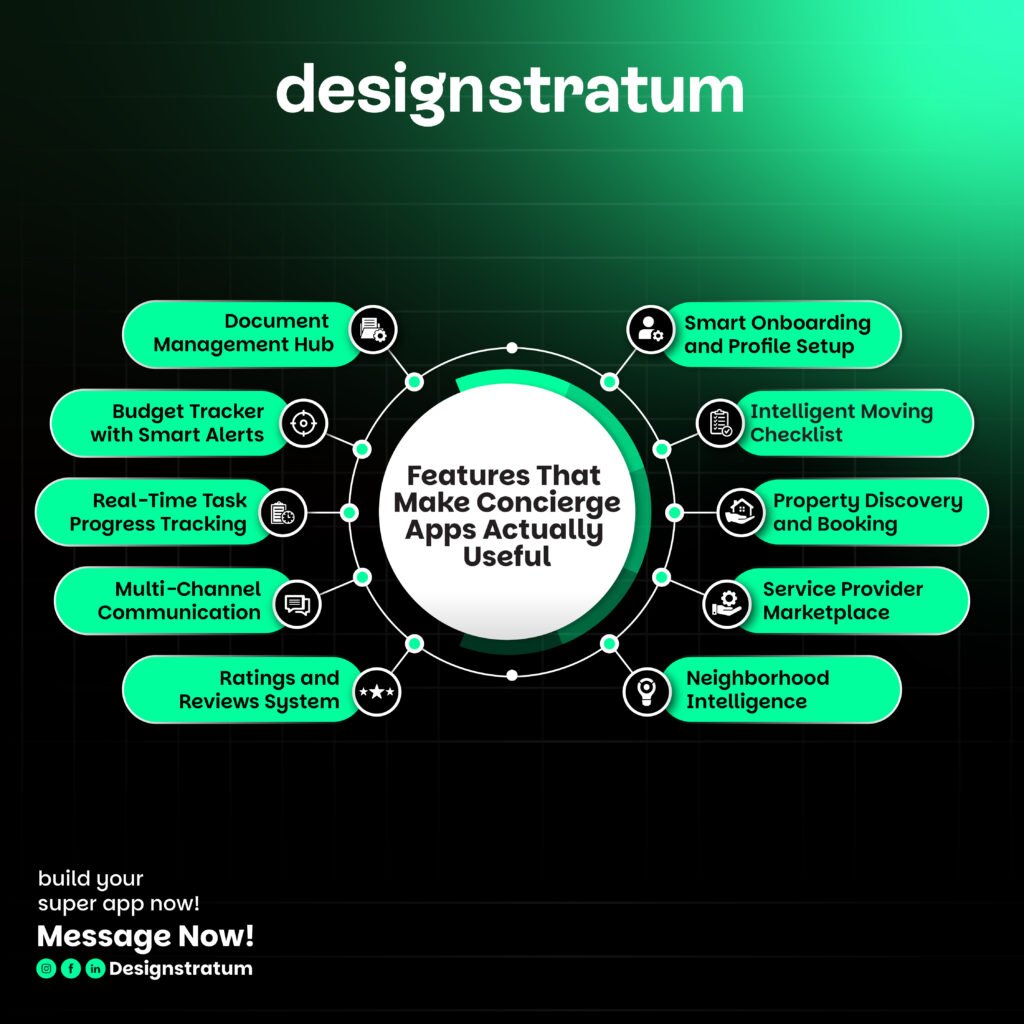
Smooth Onboarding and Profile Creation: The app must be smart enough to see the situation of individual users. Whither are they going to and whence? What’s their timeline? Do they move alone or with family? Renting or buying? Domestic or international? All other things that the app accomplishes are motivated by these answers.
Smart Moving Checklist: It is so much more than a to-do list. The app must create a custom, stage-based checklist, which evolves according to the type of the move of the user. An individual travelling abroad should be reminded of visa papers. A family requires school enrollment activities. As a renter, there must be termination steps to a lease. The checklist must also be updated in real-time in case a user finishes a task or the timelines are altered.
Property Discovery and Booking: Get connected with the real estate websites so that people can search the houses, apartments, or other typical housing options directly in your app and add the filters with respect to their needs (school districts, commute time, budget, neighborhood features). Allow them to save favorites, bookings, and even start lease applications without leaving the site.
Service Provider Marketplace: This is the heart of your concierge offering. Users need to find, compare, and book:
- Moving and packing companies
- Storage facilities
- Cleaning services
- Handymen and contractors
- Utility providers (electricity, gas, water, internet)
- Insurance providers
- Pet relocation services
The key differentiator here is quality control. Don’t just list every provider vet partners, verify licensing and insurance, collect authentic reviews, and remove underperformers. Your reputation depends on recommending trustworthy services.
Neighborhood Intelligence: Help newcomers understand their destination before arriving. What are the good grocery stores? Where’s the nearest urgent care? Which areas have the best coffee shops or nightlife? What’s the public transportation like? This goes beyond what Google Maps shows provide curated, local knowledge that helps people feel at home faster.
Document Management Hub: People need quick access to important documents during moves lease agreements, insurance policies, medical records, school transcripts, visa paperwork, inventory lists. Provide secure, encrypted cloud storage with easy mobile access. Bonus points for OCR scanning that automatically categorizes documents.
Budget Tracker with Smart Alerts: Most people underestimate moving costs by 30-40%. Build a comprehensive budget tool that helps users estimate expenses, track actual spending, and get warned when they are approaching or exceeding budget limits. Include cost estimation calculators for different services.
Real-Time Task Progress Tracking: Users should see exactly where they stand at any moment. What percentage of tasks are complete? What’s coming up next? Are they on schedule? Visual progress indicators reduce anxiety by making an overwhelming process feel manageable.
Multi-Channel Communication: Integrate chat, video calling, and phone support so users can reach concierge staff however they prefer. Some people want to quickly text a question, others need to talk through complex issues. Also include an AI-powered chatbot for instant answers to common questions 24/7.
Ratings and Reviews System: Let users rate their experience with service providers and share feedback. This helps other users make informed decisions and incentivizes vendors to maintain high service quality.
Critical Admin and Backend Features
Detailed Admin Dashboard: Your team must have a single, centralized view of all users, active relocations, service provider partner relations, revenue metrics and support tickets. The good dashboards bring forth the key issues automatically to ensure that nothing slips through the cracks.
Vendor Management System: Monitor all service provider relationships, watch their performance metrics (response times, completion rates, customer satisfaction), manage contracts and commission structure and automatically make payments.
Customer Support Infrastructure: This should be a ticketing which follows all user inquiries, assigned to respective team members, response time and nothing which is not addressed. Provide canned answers to frequently asked questions in order to save time.
Payment Processing and Financial Tools: Integrate secure payment gateways to accept subscriptions, one-time purchases and pay vendors. Give the customer extensive invoice and receipts. Design in fraud detection and PCI compliance.
Analytics and Reporting: See all that matters: user acquisition sources, activation rates, feature usage, completion rate, revenue per user, churn rates, vendor performance, and customer satisfaction scores. Statistics make superior decisions.
Advanced Features That Differentiate Great Apps
- AI-Powered Recommendations: Machine learning can be used to propose neighborhoods that users like, anticipate their future services, and plan their moving schedule using thousands of successful past relocations.
- Plan AR Room: The app allows users to see how furniture will look in their new home before they move in. They are able to measure the rooms, place virtual furniture and layout plans and this eliminates the stress of identifying whether everything will fit.
- Calendar Integration: Sync with Google Calendar, Outlook or Apple Calendar to have the tasks and appointments displayed in addition to other commitments of the user. This will avoid conflicts of schedule and enhance the completion rates of tasks.
- Multilingual Assistance: Necessary to international moves. Provide the user interface and support in different languages, and also think of offering translation services of documents.
- Community Features: Introduce newcomers to other new transplants in their community. Social isolation is a legitimate issue when relocating to a new place and assisting people in networking is an enormous value addition.
- Carbon Footprint Calculator: Environmentally-conscious customers would like to know and reduce the environmental footprint of their moving. Measure transportation emissions, propose green moving, and provide carbon offset.
How to Develop a Relocation Concierge Mobile App: Step-by-Step Process
Understanding how to develop a relocation concierge mobile app requires breaking down the process into manageable phases. Here’s the proven roadmap that successful apps follow:
Phase 1: Market Research and Validation (3-4 weeks)
Begin with in-depth market research. Interview individuals that have relocated at least 20-30 within varied move categories. What frustrated them most? What would they have paid for? So where did they expend time or money? It is through these discussions that you know what to build.
Examine app competitors in detail. Install/Download existing concierge applications, Go through complete user flows, Take notes on what works and what is clunky. Read those reviews in the app stores and they will inform you of what is missing or broken.
Narrow your first target market. The move everybody is too general. Perhaps begin with a “corporate professionals moving within the country in their search of employment” or with an international student moving to the US universities. Niche marketing is more productive.
Develop elaborate user personas not only demographics but also motivations, fears, behavior and context. Sarah is a 32-year-old marketing manager, who moves to Seattle and takes up a new position after leaving Austin. She is anxious about finding a place to live distantly, fearful of adapting to a novel city, and annoyed by the fact that the moving procedure seems to be disjointed.
Draw full user paths between initial awareness into well established in the new location. Determine all of the touchpoints, decision points, and possible points of friction. This is made your blueprint of the product.
Phase 2: Strategic Planning and Feature Definition (2-3 weeks)
Make your basic value proposition. How is your concierge app differentiated among the available solutions? Perhaps, it is more thorough vetting of service providers, white-glove human care, improved AI suggestions or niche orientation such as internationally corporate relocations.
Be merciless about your MVP (Minimum Viable Product). You can never construct everything in one place. Select 5-7 features that will bring the highest value to your target users. In the majority of relocation applications, it consists of: onboarding of the user, customized checklist, booking with a list of service providers, document storage, and chat support provided by concierge.
Select a technology stack depending on the ability of your team and the project needs. Which types of native apps do you plan to construct? Or will you cross-platform? What is the backward infrastructure that would be reasonable? What are the third party services that you will incorporate? Such choices have an enormous effect on the rate of development and costs.
Develop a feasible project schedule and budget. Prices of development depend on many factors such as complexity, location of the team, and features. The bare minimum would be priced at $50,000-100,000, and the full-fledged version would cost between 150,000 and 300,000+.
Phase 3: Design and Prototyping (4-6 weeks)
Begin with low-fidelity wireframes that reveal rough screen layouts and flows of navigation. Do not think about visual design but think about information architecture and user flow logic.
Generates clickable prototypes with Figma or Adobe XD. These are to be real enough to be tested with the potential users. Take people through the process of important activities such as booking a mover or locating a neighborhood and observe where they get stuck.
Write an elaborate system not simply single screens. Establish your colors, typography, iconographic, space system, and component library. This leads to uniformity and accelerates development.
Place a maniacal emphasis on the onboarding flow. The first two minutes determine whether the users invest in your app or not. It is important to be very clear about what your value is and how the app will be used to their benefit.
Test real users prior to commencing development. Only five users will expose 80 percent of the significant usability challenges. Not after you have completed a whole job get around to fixing them when a little alteration is costly.
Phase 4: Development and Integration (12-20 weeks)
This is where your concierge app comes to life. Development timelines vary significantly based on complexity and team size.
A common question is how long does it take to develop an app? For a relocation concierge platform, expect:
- Basic MVP: 12-16 weeks with a small team
- Mid-complexity app: 16-24 weeks with moderate features and integrations
- Full-featured platform: 24-32 weeks with advanced AI, multiple integrations, and enterprise features
Sprint in two-week cycles with objectives and deliverables. At the close of a sprint, present working features to the stakeholders. This keeps all on track and enables corrections on the course.
Build the business logic, databases, servers, and the front end (what the user sees and interacts with) in parallel. Coordinate so well so that they fit well.
Introduce third-party integrations selectively, payment gateways, mapping solutions, calendar integration, communication, and storage through the cloud. Testing is necessary to make sure that every integration is reliable.
Decade Tests Auto-tests on key functionality user registration, payment flow, booking flows. Manual testing identifies UX bugs, automated tests avoid regression bugs as you continue to add functionality.
Phase 5: Quality Assurance and Testing (4-6 weeks)
Conduct comprehensive QA testing across multiple devices and OS versions. Test on actual devices, don’t just use simulators, hardware differences matter. Try to cover various scenarios such as slow internet connections, different screen sizes, interrupted user flows.
Run beta tests with at least 50-100 real users planning actual moves. Give them free or discounted access in exchange for detailed feedback. Watch analytics to see which features they use and where they drop off.
Performance test under realistic loads. What happens when 1,000 users try to book movers simultaneously? Can your database handle the queries? Do pages load quickly enough? Aim for sub-2-second load times for critical screens.
Security test everything that handles sensitive data. Hire professionals to perform penetration testing. You cannot compromise on security with an app handling financial information, personal details, and important documents.
Fix critical bugs and usability issues discovered during testing. Prioritize issues that block core functionality or create security vulnerabilities.
Phase 6: Launch Preparation and Deployment (2-3 weeks)
Prepare your app store listings with compelling descriptions, screenshots, and preview videos. Research keywords for App Store Optimization (ASO) to improve discoverability. Terms like “relocation app,” “moving assistant,” and “concierge app” should appear naturally in your descriptions.
Set up analytics and monitoring tools so you can track app performance and user behavior from day one. Implement crash reporting to quickly identify and fix issues.
Create your customer support infrastructure help documentation, FAQ sections, ticketing system, and train your concierge team on how to use your admin dashboard and support tools.
Plan your soft launch strategy. Start with a limited geographic market or specific user segment where you can validate operations at a small scale before expanding.
Submit your app to Apple App Store and Google Play Store. Apple’s review process typically takes 1-3 days, while Google’s is usually faster. Have backup plans if your app gets rejected it happens more often than you’d think.
Phase 7: Post-Launch Iteration and Growth (Ongoing)
Launch isn’t the finish line it is the starting point. Collect feedback obsessively and prioritize ruthlessly. Users will request hundreds of features. Build only what moves key metrics user activation, task completion rates, bookings generated, and retention.
Monitor your key performance indicators daily. Which user acquisition channels work best? Where do users drop off? Which features drive engagement? What’s your retention rate after 30 days? Data tells you where to focus improvement efforts.
Plan regular releases with new features and improvements. Ship updates every 2-4 weeks to maintain momentum and show users you are actively improving their experience.
Scale your service provider network as you expand to new markets. Quality control becomes increasingly important as you grow one bad vendor experience can tank your reputation.
Choosing the Right Technology Stack
Your technology choices impact everything development speed, costs, app performance, scalability, and maintenance requirements. Furthermore here’s what you need to think through when determining how to develop a relocation concierge mobile app:
Mobile Development Approach
Cross-Platform Frameworks: React Native and Flutter allow you to code in a single language and deploy to iOS and Android. This reduces the time of development by half and simplifies maintenance. What’s more, Performance is good, and you can also access the native device features when you need them.
Native Development: Swift on iOs and Kotlin on Android provide the highest performance and availability of the most recent platform capabilities. Use this path when you have requirements specific to platforms, or a sufficiently large team to support disaggregated codebases.
Progressive Web Apps: Take into account the development of a PWA and native apps. Apart from some users who choose to use services in the browser, PWAs are compatible with all devices and do not require downloading applications in an app store.
Backend Infrastructure
Server Framework: Node.js excels for real-time features like chat and notifications. Python with Django provides excellent data processing libraries and rapid development. Ruby on Rails remains great for building feature-rich applications quickly.
Database: PostgreSQL handles complex relational data beautifully perfect for storing user profiles, service provider information, bookings, and relationships between entities. MongoDB offers flexibility for unstructured data. Firebase provides a complete backend solution excellent for MVPs.
Cloud Hosting: AWS, Google Cloud, or Microsoft Azure all provide reliable infrastructure with global reach. Choose based on your team’s expertise and specific service needs. Cloud hosting gives you the security, compliance, and scaling capabilities essential for handling sensitive user data.
Essential Third-Party Services
Payment Processing: Stripe offers the best developer experience and supports subscriptions, one-time payments, and marketplace features. Ensure PCI DSS compliance from the start.
Mapping Services: Google Maps provides comprehensive data and familiar interface. Mapbox offers more customization and often costs less at scale.
Communication Tools: Twilio handles SMS notifications and voice calls. SendGrid manages transactional emails. Stream or Sendbird provide chat infrastructure.
Analytics: Mixpanel or Amplitude track user behavior and help you understand feature usage. Set up proper event tracking from launch day.
Cloud Storage: AWS S3 or Google Cloud Storage for user documents and media files. Ensure encryption at rest and in transit.
Monetization Strategies That Generate Real Revenue
The most successful concierge apps combine multiple revenue streams rather than depending on one source:
Tiered Subscriptions: Offer a free basic tier that provides value but limits features. Charge $29-49 for premium individual access with unlimited services, priority support, and advanced features. Corporate subscriptions run $199-499 per employee relocation with volume discounts for companies relocating frequently.
Service Provider Commissions: Take 5-15% commission on services booked through your platform. Moving companies, storage facilities, cleaning services, and other vendors happily pay this since you are delivering qualified leads. Real estate agent referrals can earn 20-30% of agent commissions, often $2,000-4,000 per transaction.
Transaction Fees: Charge small fees for premium services like expedited document processing, dedicated concierge time, or same-day service provider bookings. Users accept these fees when they are buying convenience and speed.
Corporate Contracts: This is where the big money lives. Companies relocating employees regularly will pay annual contracts worth $50,000-500,000+ depending on relocation volume. Focus on building relationships with corporate HR departments and mobility managers.
Featured Listings: Service providers pay for prominent placement in search results or featured badges that increase their visibility. This works only if you maintain quality standards don’t sacrifice user trust for quick revenue.
White-Label Licensing: License your platform to corporations, real estate companies, or relocation management companies who want to offer the service under their brand. This creates additional revenue without additional customer acquisition costs.
Marketing Strategies That Build Your User Base
Building a great app means nothing if people don’t know it exists. Here’s what works:
Content Marketing and SEO: Prepare detailed guides of relocating matters, neighborhood comparisons, cost estimators, moving checklists, local area guides. This draws organic traffic of individuals on moves. Always publish and find the right keywords that people search for.
Corporate Partnerships: Direct sales to HR departments results in high value users that are highly retained. Develop case studies of your ROI, establish relationships with mobility managers and HR directors, Research companies that have big relocation budgets.
Real Estate Agent Partnerships: Agents deal with people that are in a state of motion. Collaborate with agencies in order to suggest your app to their customers. Provide co-branded or referral charges. A single successful real estate partnership may have dozens of users every month.
App Store Optimization: Apps are mostly found during the search by the users. Maximize your title, description and keywords of your app. Concentrate on what you do and not what you possess. Gather good reviews forcefully.
Referral Programs: The people who will be able to successfully relocate with your help will refer to friends and family with incentives in particular. Provide discounts or free premium services to successful referrals to both parties.
Specific Digital Advertising: Place Google Ads when people search such words as moving to [city] or relocation services. Ads on Facebook and LinkedIn are efficient in addressing people who have recently changed their job or informed about their intentions.
Common Challenges and How to Overcome Them
Good Quality Control of the Service Provider: The quality of the vendors you suggest determines your whole reputation. Apply tough vetting policies, gather verified reviews, and fire non-performers fast. Book the best providers physically then include them in your system.
User Retention: Since people move with intervals, it is difficult to retain them. Centre on ensuring that every relocation experience is so incredible such that users refer their friends. Look at the opportunity of additional services (home maintenance, local services) to keep it alive after the move.
Geographic Expansion: Construction of networks by building service providers in new cities is time consuming. Begin with big metropolitan centers where there is high demand and then spread out logically instead of trying to be everywhere simultaneously.
Technical Scalability: Growing starting at the beginning. Scale on command by using the cloud infrastructure, use caching techniques, minimize database queries and track performance on a regular basis.
Customer Support Load: Relocations are stressful and time-related. Users expect fast responses. Invest in high-quality support infrastructure, provide proper training to your team and automate (chatbots, FAQs) to address the most frequent questions.
Conclusion: Building Something People Actually Need
To conclude The relocation business is poised to be disrupted, however, the building of an app is not the solution to success. Find out how to address the real pain points, how to create a smooth UI/UX that will make the user less stressed, and how to master the experience of a single group of people and only then multiply it by the number of users.
Millions of people migrate annually and are ready to spend money to get solutions that are free of stress. A relocation concierge app can be effective and lucrative with the appropriate design, execution, and collaborations.
When you are willing to implement your idea, then Contact our design team we design and develop customer mobile apps that are loved by the users.
The issue is not whether there is an opportunity or not, it is whether you will perform adequately to win the opportunity. You now possess all you require to begin developing a relocation concierge app that people would actually desire to utilize.