
Introduction
In 2025, social media website development is more than just a tech project. It’s a brand opportunity. We’ve seen how social media has matured from a place for casual networking (largely for Gen Z, millennials, and generation X) to places where businesses are established on trust, creators expand their audiences and communities flourish. As per KEPIOS, there are around 5.3 billion active social media users globally. And people on average spend more than 3 hours on these social platforms every day.
Furthermore, having your own social platform gives brands full control over engagement, design, and data. Whether you want to create a social media website for your company, a niche audience, or a creative network, having a solid roadmap matters a lot.
This guide is nothing less than a complete breakdown of how to build a social media website, what types exist, and how modern brands can benefit from developing their own.
Why is social media website Development important in 2025
Today’s users want more than just a place to chat. They crave authenticity, privacy, and tailored content. As mainstream platforms grow crowded, niche communities rise. That’s why developing a social media website in 2025 is a smart move.
Here’s why it matters:
- Direct connection: Build a space where your audience interacts without algorithmic noise.
- Brand control: Customize features, tone, and content flow.
- Data ownership: Gain insight without third-party dependency.
- Innovation freedom: Test creative ideas faster than on mainstream networks.
Furthermore, modern technology simplifies the process. Cloud hosting, AI-powered moderation, and pre-built frameworks have lowered entry barriers dramatically.
According to Forbes, brands that own their audience through online communities see up to 2.5x higher engagement than those depending solely on third-party platforms.
Additionally, your own platform improves brand loyalty. People connect more deeply when they feel part of something built with purpose. In short, social media website development offers both independence and innovation.
Social Media Website Development: Types and Categories
Before you create a social media website, know what kind fits your vision. Every category targets a unique audience and experience.
| Type | Description | Examples |
| Networking | Connect users and professionals | LinkedIn, Facebook |
| Media Sharing | Share photos, videos, and reels | Instagram, TikTok, YouTube |
| Microblogging | Post short thoughts and updates | X (Twitter), Threads |
| Discussion Forums | Exchange ideas and advice | Reddit, Quora |
| Community Platforms | Build niche groups | Discord, Geneva |
| Social Commerce | Combine shopping and networking | Pinterest, Depop |
| Decentralized Networks | User-owned, privacy-first | Mastodon, Lens Protocol |
Furthermore, identifying your type helps narrow down your social media website design choices.
Ask yourself:
- Do I want visuals to lead?
- Is conversation the goal?
- Should users sell, post, or share ideas?
Your answers define your development path.
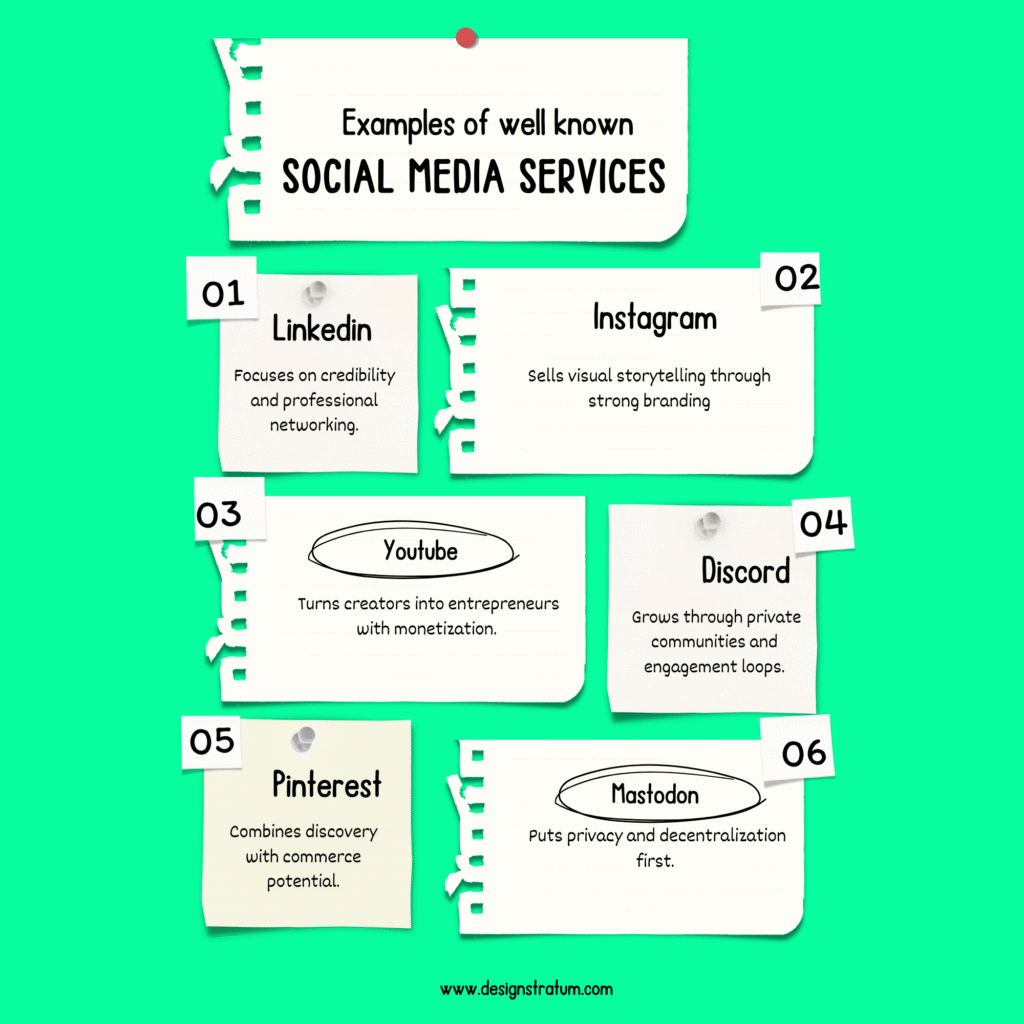
Examples of Well-Known Social Media Services
Learning from existing platforms is key before you build your social media website.
Let’s look at what works:
- LinkedIn: Focuses on credibility and professional networking.
- Instagram: Sells visual storytelling through strong branding.
- YouTube: Turns creators into entrepreneurs with monetization.
- Discord: Grows through private communities and engagement loops.
- Pinterest: Combines discovery with commerce potential.
- Mastodon: Puts privacy and decentralization first.
Furthermore, each platform succeeds because of a clear purpose and user experience. As hootsuite highlights the most successful social apps of 2025 are those that balance personalization, privacy, and purpose. For instance, YouTube keeps creators loyal through earning potential, while Discord thrives on real-time communication.
Additionally, these examples show that innovation isn’t about copying, it’s about filling a gap. Find what others miss, then build your platform around it.
In social media website development, clarity of purpose beats complexity every time.
Define Your Product and Audience.
To succeed, define your audience before writing a single line of code. Your platform should solve a real need.
Steps to get started:
- Identify who you serve: professionals, creators, or hobbyists.
- Understand their pain points: content discovery, privacy, or monetization.
- Set clear goals: engagement, brand visibility, or community loyalty.
Furthermore, start small focus on core features like profiles, posts, messaging, and notifications. Avoid feature overload during early social media website design.
Additionally, align your design and tone with your audience’s habits. Young creators may want vibrant visuals, while professionals prefer minimalist layouts.
When you know who you’re building for, every button and interaction will feel intentional. That focus makes scaling smoother and marketing easier.
Technical Foundations: Building Smart and Scalable
The backbone of social media website development is choosing the right tech stack.
Recommended Tools:
- Frontend: React or Next.js for speed and flexibility.
- Backend: Node.js, Django, or Laravel for reliability.
- Database: PostgreSQL or MongoDB for secure storage.
- Hosting: AWS, Google Cloud, or Vercel for scalability.
- Security: OAuth login, SSL, and two-factor authentication.
Furthermore, use APIs for chat, media upload, and notifications to save time.
Additionally, consider starting with a social media website template it saves effort while maintaining customization options. Templates already include responsive layouts, UI elements, and page structures.
Remember, performance matters. Users leave slow platforms quickly. Optimize loading speed, mobile responsiveness, and caching.
A strong technical base ensures your platform runs smoothly even as your audience grows.
Case Studies: Lessons from Real Success Stories
After setting up a strong technical foundation, it helps to look at real-world examples of platforms that turned solid tech and smart strategy into global success. Case studies like Twitch and Discord show how the right mix of community focus, scalability, and user experience can transform a simple idea into a thriving digital ecosystem.
Both began with narrow audiences such as gamers but through consistent innovation and audience understanding, they evolved into massive social ecosystems. Let’s explore what made them stand out.
Case Studies: Real Success Stories
Twitch – Building Communities Through Live Interaction
- Launch: 2011, focused on gaming livestreams
- Users: 140M+ monthly active users (2025)
- Core Strengths:
- Real-time engagement with live chat and emotes
- Scalable infrastructure supporting millions of concurrent streams
- Creator economy with subscriptions, donations, and partnerships
- Real-time engagement with live chat and emotes
- Key Takeaway: Platforms that prioritize interactive, real-time communities outperform passive content networks.
Discord — The Rise of Private, Interest-Based Networks
- Launch: 2015, originally for gamers
- Users: 600M+ registered users (2025)
- Core Strengths:
- Private, self-moderated servers for niche communities
- Voice, video, and text channels with minimal latency
- Customization with roles, permissions, and bots
- Private, self-moderated servers for niche communities
- Key Takeaway: Modern users value privacy, control, and niche-focused spaces over algorithm-driven feeds.
Design, Branding, and Marketing Integration
Your social media website design defines first impressions. Good design builds trust and keeps users coming back.
Design Essentials:
- Clean navigation and simple sign-up flow.
- Clear typography and consistent colors.
- Visible CTAs (like post, follow, or share).
- Engaging visuals and smooth animations.
Furthermore, merge website design and social media marketing strategies. Use visuals, hashtags, and share buttons that encourage user-generated content.
Additionally, design for inclusivity accessible fonts, dark mode, and mobile-first layouts.
Think of design as storytelling. Every element should reflect your platform’s identity and mission. When your branding and functionality align, your community feels cohesive and professional.
A well-designed interface not only attracts users but also helps your marketing campaigns perform better.
Conclusion
In 2025, building a social media website is more than just a website. It is more of a playground that people are trying to build. And no its not just about the slides and swings (the features), it’s about making a place where people actually want to hang out.
Think of it like this: you’re not just writing code; you’re setting up a neighborhood where people can talk, laugh, and share stories. The better the vibe with the platform the longer they’ll stay.
Before you start, figure out what kind of playground you’re making. Is it a quiet park for deep talks or a buzzing carnival full of fun and games? Study the ones that already work well like how Instagram makes things simple or how Reddit builds strong communities. Then, build yours with that same care.You can start with a template or build from scratch but either way, keep it simple, fast, and friendly. But ultimately to create a social media website that lasts, focus on people first and features second. Build something they’ll love to use every day.