
Many agencies build dozens of websites every month without having a large in-house development team. The secret? White label web development.
If you run a digital agency, a design studio, or even a freelance operation, you have probably faced this situation: a client needs a fully functional website, but your team is stretched thin, your developers are booked, or you simply do not have the technical expertise in-house to deliver. What do you do? Turn down the project and lose revenue? Rush the work and risk quality? Neither option is ideal.
This is exactly where white label web development has become a game-changer. According to Clutch, demand for outsourced development services has grown significantly as agencies look for scalable, cost-effective ways to deliver more for their clients. Over the past decade, more agencies and businesses have quietly adopted this model to handle growing client demands, expand their service offerings, and remain competitive all without the burden of hiring large internal teams.
In this guide, we will break down everything you need to know about white label web development, from what it actually means to how to find the right partner for your business.
What Is White Label Web Development?
White label web development is a business arrangement in which one company a specialized development team builds websites or web applications on behalf of another company, which then presents the finished product to its own clients under its own brand name.
In simple terms: someone else does the building, but your name goes on the door.
The end client, the person or business that commissioned the website, typically never knows a white label developer was involved. As far as they are concerned, the agency they hired handled everything. The white label development partner works entirely in the background.
Here is a straightforward example of how it plays out:
- A marketing agency wins a contract to build a new e-commerce website for a retail client.
- The agency does not have dedicated developers available, so they partner with a white label web development agency.
- The white label team builds the website according to the agency’s specifications.
- The agency reviews the work, manages client communication, and delivers the final product under their own branding.
- The client receives a polished website and associates the success entirely with the agency.
This model benefits everyone in the chain. The agency grows its revenue without scaling its team. The white label developer gets consistent, ongoing work. And the end client gets a high-quality product delivered on time.
How White Label Web Development Works
Understanding the process helps agencies determine whether this model fits their workflow. Here is a step-by-step breakdown of how a typical white label web development engagement unfolds:
Step 1: The Agency Signs a Client
The agency closes a web development deal with their client. This could be a new website build, a redesign, an e-commerce platform, or a custom web application.
Step 2: Requirements Are Gathered
The agency collects all the necessary information from the client design preferences, functionality requirements, brand guidelines, content, timelines, and budget. This information is then passed on to the white label partner.
Step 3: The White Label Development Team Gets to Work
The white label web developer builds the website based on the provided brief. Development happens entirely under the hood, invisible to the end client. This is where having a reliable web development partner makes all the difference experienced teams with structured workflows minimize errors and keep projects moving.
Step 4: Review and Feedback Loop
The agency acts as the middle layer. They review the work from the white label team, request revisions if needed, and relay client feedback without exposing the third-party involvement.
Step 5: Final Delivery Under the Agency’s Brand
Once the project is complete and approved, the agency delivers the finished website to their client. All branding, communication, and credit belong to the agency.
This process keeps the relationship clean, professional, and entirely within the agency’s control.
Who Uses White Label Web Development?
White label web development services are not limited to one type of business. A wide range of professionals and organizations use this model to operate more efficiently:
Digital Marketing Agencies are perhaps the most common users. They often manage SEO, paid ads, and social media for clients who also need websites but maintaining a full development team is costly.
Design Studios excel at visual branding and UX but may lack back-end development resources. White label partnerships allow them to offer complete digital solutions. Studios that already provide UI/UX design services can seamlessly extend their offering to include full web development through a white label arrangement.
SEO Agencies frequently need landing pages, site restructures, or technical fixes that require development expertise. Outsourcing to a white label web developer fills that gap quickly.
Startups building their product or service often need a web presence fast, without the overhead of hiring permanent staff in the early stages. Many early-stage companies benefit from working with a startup-focused brand and design agency that understands both design and development requirements.
Freelancers who work solo can punch well above their weight by partnering with white label teams. A solo consultant can take on enterprise-level projects and deliver them through a trusted white label partner.
IT Consultants and managed service providers can expand into web development without retooling their entire business.
Services Usually Offered by White Label Web Development Agencies
A reputable white label web development agency typically offers a comprehensive suite of services, including:
- Custom website development Fully bespoke websites built from scratch to match unique brand and business requirements.
- WordPress development Theme customization, plugin development, and full WordPress builds. Understanding what a custom WordPress development agency actually delivers in 2026 can help set the right expectations for your projects.
- E-commerce website development Shopify, WooCommerce, and Magento builds for businesses selling products online.
- Web application development More complex, functional web apps built with modern frameworks.
- UI/UX implementation Turning design mockups into pixel-perfect, interactive front-end experiences.
- Website maintenance and support Ongoing updates, security patches, and performance monitoring.
- Landing page design and development High-converting pages for marketing campaigns.
- CMS integration Setting up and customizing content management systems so clients can manage their own content.
When you outsource web development to a white label partner, you effectively gain access to an entire development department without the associated payroll.
Benefits of White Label Web Development
The growing popularity of white label web development is not accidental. The model offers clear, tangible advantages for agencies and businesses of all sizes.
A. Faster Scaling Without Hiring
Hiring developers is expensive and slow. Recruiting, onboarding, and retaining skilled talent takes months and carries significant ongoing costs. According to LinkedIn’s Economic Graph research, software development roles consistently rank among the hardest positions to fill. White label web development allows agencies to take on more projects immediately, scaling up as demand increases without adding permanent headcount.
B. Significant Cost Efficiency
When you outsource web development through a white label arrangement, you only pay for the work you need, when you need it. There are no salaries, benefits, office space, or equipment costs tied to developers who sit idle between projects. The savings can be substantial, especially for small and mid-sized agencies.
C. Access to Specialized Expertise
A good white label web development agency employs specialists front-end developers, back-end engineers, WordPress experts, e-commerce developers, and more. Rather than relying on generalist in-house staff, agencies gain access to deep, specialized knowledge. Knowing how to choose the right web development partner is what separates agencies that scale successfully from those that struggle with inconsistent output.
D. Focus on Core Business Activities
With development handled externally, agency leadership and account managers can focus on what they do best: winning clients, building relationships, developing strategy, and growing the brand. The operational heavy lifting of development is removed from their plate.
E. Faster Project Delivery
Dedicated white label teams are structured around delivery. With clear processes, experienced developers, and no internal distractions, they often deliver projects faster than an in-house team juggling multiple responsibilities. Faster delivery means happier clients and more capacity for new work.
Challenges and Risks to Consider
White label web development is not without its difficulties. Agencies should go in with a clear understanding of the potential risks:
Communication Gaps Working with an external team adds a layer of distance between the agency and the developers. Miscommunication around requirements, scope, or feedback can cause delays and rework.
Quality Control Concerns Not all white label partners maintain the same standards. Without proper vetting, agencies risk delivering subpar work to their clients, which directly reflects on their own reputation.
Time Zone Differences If the white label team operates in a different country or region, coordinating meetings and managing turnaround times requires deliberate planning.
Dependency on External Teams Over time, relying heavily on a white label partner can create vulnerability. If the partnership ends suddenly, the agency may struggle to fulfill commitments.
Confidentiality Issues Sharing client briefs and project details with a third party requires trust and formal agreements. Google’s developer program policies offer useful context around data handling and third-party collaboration responsibilities.
The good news is that these challenges can largely be managed with the right processes, clear contracts, proper onboarding, and consistent communication. Most established white label agencies have systems in place to address all of these concerns proactively.
White Label Web Development vs. Outsourcing: What Is the Difference?
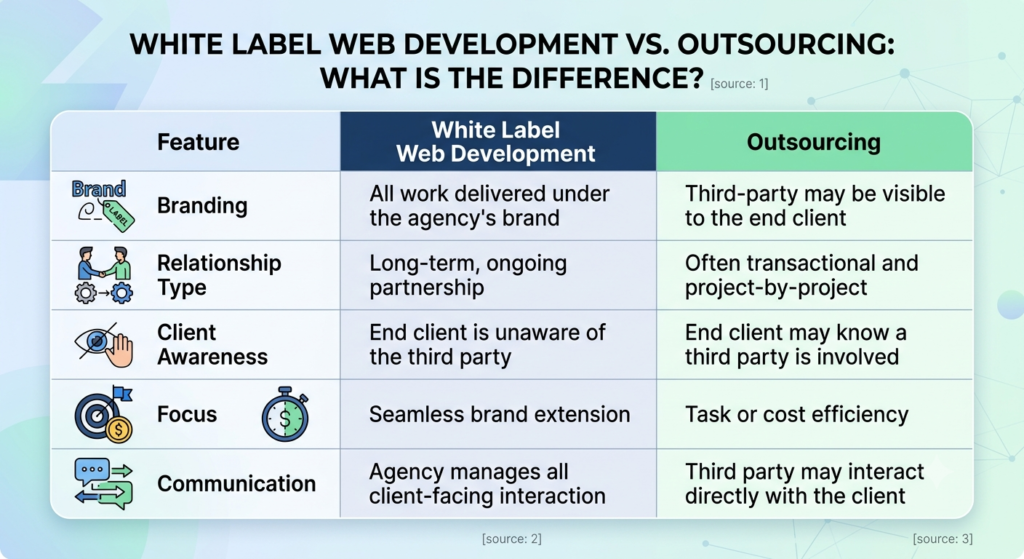
These two terms are sometimes used interchangeably, but there is an important distinction worth understanding.
| White Label Web Development | Outsourcing | |
| Branding | All work delivered under the agency’s brand | Third-party may be visible to the end client |
| Relationship Type | Long-term, ongoing partnership | Often transactional and project-by-project |
| Client Awareness | End client is unaware of the third party | End client may know a third party is involved |
| Focus | Seamless brand extension | Task or cost efficiency |
| Communication | Agency manages all client-facing interaction | Third party may interact directly with the client |
When you outsource web development in the traditional sense, your client might know another company is doing the work. In a white label arrangement, that transparency is replaced by complete brand continuity. The agency owns the relationship entirely.
For agencies that want to maintain a consistent brand image and strong client relationships, white label is generally the preferred approach over conventional outsourcing. Statista’s IT outsourcing market data shows the sector continues to grow globally, with white label models increasingly favored by agencies prioritizing brand control.
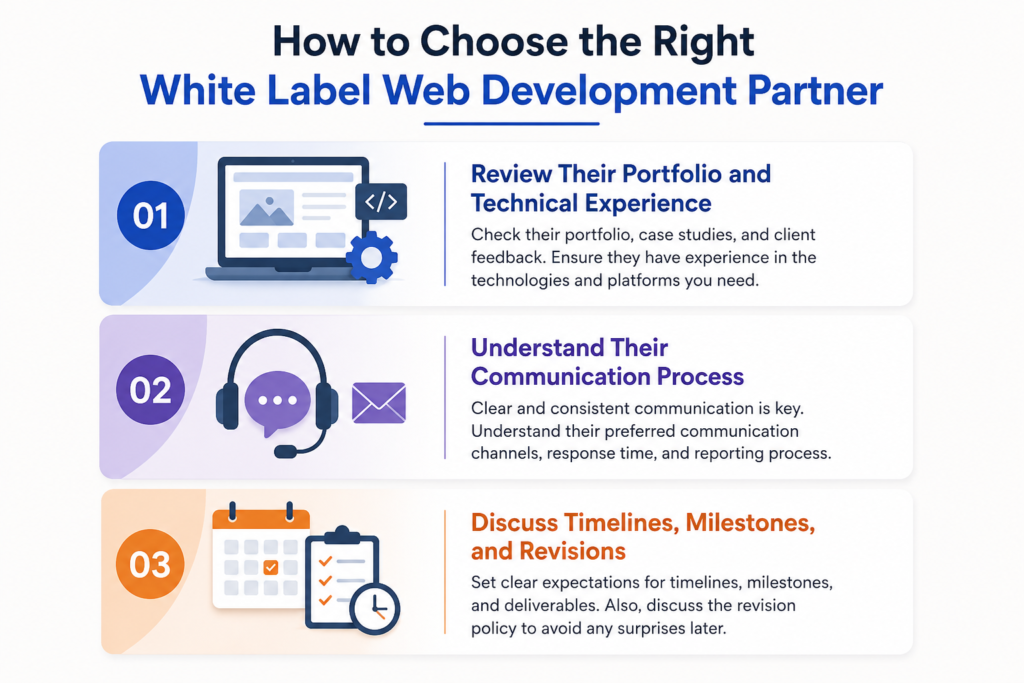
How to Choose the Right White Label Web Development Partner
Selecting the right partner is the most critical decision in this process. Here is what to look for when evaluating a white label web development agency:
1. Review Their Portfolio and Technical Experience Look at previous projects. Are they building the types of websites you need custom builds, WordPress, e-commerce, web apps? Experience matters more than promises. Reviewing real client work and case studies gives you a far better picture than a sales pitch ever will.
2. Understand Their Communication Process How do they handle project briefs? What tools do they use for updates and collaboration? Agencies need partners who communicate clearly and consistently, not ones who go silent and resurface with a finished product that misses the mark.
3. Discuss Timelines, Milestones, and Revisions Get clarity on how long projects take, how revisions are handled, and what happens if deadlines slip. A professional white label web developer will have clear, structured processes for all of this.
4. Review Confidentiality and NDA Agreements Before sharing any client information, ensure the partner is willing to sign a non-disclosure agreement. This protects your clients and your agency’s reputation.
5. Start With a Smaller Project Before committing to a long-term partnership, run a small, lower-stakes project through the partner. This is the most reliable way to evaluate their quality, communication, and reliability before the stakes are high.
If you are actively evaluating partners, Design Stratum’s web development services offer a transparent, process-driven approach built for agencies looking for a reliable, brand-safe white label collaboration.
Is White Label Web Development Right for Your Business?
Not every agency or business needs a white label partner, but for many, it is the smartest growth move available. Consider whether any of these situations apply to you:
- Your agency is winning more web development projects than your current team can handle.
- You want to offer web development as a service but lack the technical team to deliver it.
- You are a freelancer looking to take on larger, more complex projects.
- Your in-house developers are consistently overloaded, causing delays and client dissatisfaction.
- You want to expand your service offering quickly without the time and cost of hiring.
- You are dealing with a temporary surge in demand and need flexible capacity.
If any of these resonate, white label web development services are worth exploring seriously. The model is designed precisely for these situations it gives businesses the flexibility to grow on their own terms, without the traditional constraints of staffing and infrastructure.
Frequently Asked Questions (FAQ)
“White label” means that the product or service is created by one company but branded and sold by another. In web development, a white label agency builds the website, but the company selling it to the end client takes full credit under their own brand.
Absolutely. It is a fully legitimate and widely practiced business model. As long as proper contracts and NDAs are in place, both parties are protected and the arrangement is entirely above board.
Not if the arrangement is handled professionally. White label partners are contractually obligated to remain invisible. All communication, branding, and deliverables go through the agency.
Pricing varies widely depending on the scope of work, the complexity of the project, and the partner’s location and expertise. Most white label agencies offer project-based or retainer-based pricing. Agencies typically mark up the cost and build in their own margin.
Most agencies handle a wide range, including WordPress sites, custom-coded websites, e-commerce platforms (Shopify, WooCommerce), web applications, landing pages, and CMS-driven portals.
Final Thoughts
White label web development has transformed the way agencies and businesses approach growth. Rather than being limited by the size of your internal team, you can leverage specialized expertise, deliver more projects, and serve more clients all while keeping your brand front and center.
The model is not without its challenges. Communication, quality control, and choosing the right partner all require careful attention. But for agencies that do it well, white label partnerships become a genuine competitive advantage a quiet engine running behind the scenes that allows them to operate at a scale they simply could not achieve alone.
Successful white label relationships are built on three things: trust, clear communication, and an unwavering commitment to quality on both sides of the partnership.
Whether you are a small agency or a growing business, white label web development can help you expand your capabilities without expanding your overhead. The question is not whether it works thousands of agencies prove every day that it does. The question is whether you are ready to make it work for you.
Ready to explore white label web development services for your agency? Get in touch with Design Stratum to discuss your needs, or explore our full web development services to see how we can support your growth.